
 Русский
  English
  Deutsch
  Español
  العربية
  中文
中文  Türkçe
  Français
  Italiano
What is leg axis deformity?
Leg axis deformity — disruption of normal leg alignment, in which load is distributed unevenly on the knee joint. Instead of passing through the joint center, the mechanical axis shifts, creating overload in one knee compartment.
This is the main factor in knee osteoarthritis progression. In varus deformity, the medial (inner) compartment is overloaded by 60-70%; in valgus — the lateral (outer).
Types of deformity:
- Varus (bowlegs) — knees diverge, main load on medial (inner) compartment. Most common type. Leads to medial knee osteoarthritis
- Valgus (knock-knees) — knees converge, overload of lateral (outer) compartment. Leads to lateral knee osteoarthritis
Causes:
- Osteoarthritis — cartilage destruction in one compartment → joint space narrowing → deformity
- Trauma — malunited fractures
- Genetics — congenital anatomical features
- Obesity — excess load accelerates deformity
- Meniscectomy — loss of shock absorption accelerates deformity
Facts about leg axis deformity
- ICD-10: M21.1 (varus), M21.0 (valgus)
- Varus: most common (75% of deformities)
- Overload: up to 60-70% load on one compartment
- Link to osteoarthritis: direct correlation
- Treatment: osteotomy or joint replacement
How regenerative treatment helps with deformity
Regenerative treatment does not correct bony deformity (osteotomy required for that), but regenerates damaged cartilage in the overload zone, slowing osteoarthritis progression and delaying surgery for years.
Deformity assessment
Weight-bearing X-ray and MRI determine deformity degree, cartilage condition in overloaded compartment, associated meniscus damage. Mechanical leg axis is evaluated.
Obtaining concentrates
From blood — CGF with chondrogenic and anti-inflammatory factors. From adipose tissue — MFAT with stem cells for cartilage and meniscus regeneration.
Targeted Injection
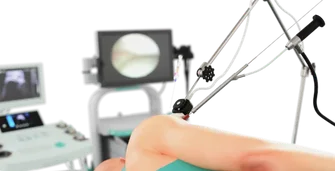
Under Ultrasound guidance navigation, concentrates are injected precisely into the overloaded compartment — into zones of maximum cartilage damage. The damaged meniscus is treated simultaneously.
Regeneration in the Overloaded Zone
Stem cells restore cartilage coverage in the overloaded compartment and reduce inflammation. Result — restoration of joint space, pain reduction, and postponement of the need for osteotomy or joint replacement.
Osteotomy vs regenerative treatment
| Criterion | Corrective Osteotomy | Regenerative treatment |
|---|---|---|
| Principle | Bone fracture + axis correction | Cartilage regeneration in overloaded zone |
| Axis Correction | ✅ Yes — mechanical correction | ❌ No — but cartilage restoration |
| Anesthesia | General / spinal | Without anesthesia |
| Rehabilitation | 3-6 months, crutches 6-8 weeks | Several days |
| Metal Implants | Plate + screws (removal after 12-18 months) | None |
| Combination | — | Excellent complement to osteotomy or orthotics |
Regenerative method Advantages
A broad range of indications
Regenerative methods are used for many orthopaedic and spinal conditions. Some cases still call for surgery.
No anesthesia or incisions
Outpatient treatment via 0.3-1.5 mm puncture. No general anesthesia or hospitalization.
No age restrictions
Regeneration at any age. Safe for chronic conditions and anesthesia intolerance.
Rapid improvement
Concentrates have analgesic and anti-inflammatory properties. Relief within days.
Multiple zones at once
Simultaneous treatment of multiple discs or joints in one procedure.
Home the same day
No crutches, braces or rehabilitation needed. MRI follow-up at 8-16 weeks.
Regenerative treatment Technology

Navigation system
Intraoperative robotic navigation system. Provides precise access to deep structures with 1 mm and 1 degree accuracy.
Ultrasound guidance
Device for intervention under sonographic control. Eliminates open surgeries with real-time visual monitoring.
Frequently Asked Questions About Leg Axis Deformity Treatment
Clinic and method matching — free of charge
Describe your case and attach your MRI report. We will identify clinics that use the relevant methods and forward your request to them. No obligation; we reply within two working days.
Send a request