 Русский
 English
 Deutsch
 Español
 العربية
 中文
 Türkçe
 Français
 Italiano


Exercise therapy and injections are not rivals: they do different jobs. When exercise is enough, when injections are worth discussing, and why combining them works best.
What exercise therapy does
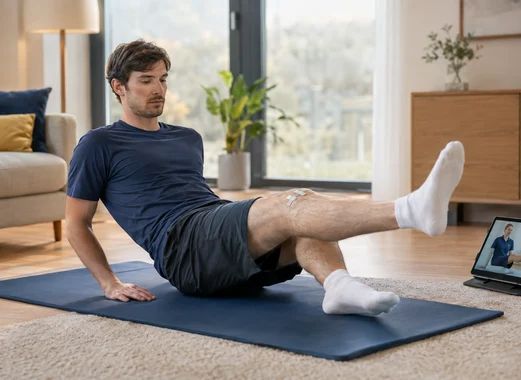
Exercise therapy strengthens muscles and improves mobility and movement control. In knee and hip osteoarthritis, chronic back pain, tendinopathies and after surgery it is the method with the strongest evidence: it reduces pain and improves function, and the effect lasts as long as the person keeps exercising.
What injections do
Corticosteroids quickly settle inflammation; hyaluronic acid, PRP and cell products reduce pain for several months in some patients. Injections help get through a flare-up and start exercising, but there is no evidence that they restore cartilage, discs or menisci.
When exercise is enough
- acute and chronic back pain without neurological deficits;
- early osteoarthritis;
- most tendinopathies at the start of treatment;
- recovery after injuries and surgery;
- preventing recurrent pain.
When injections are worth discussing
- pain prevents you from exercising;
- an osteoarthritis flare-up with joint swelling;
- a tendinopathy that has not improved after 3–6 months of proper exercise;
- radicular pain with a disc herniation — an epidural injection.
The best option is a combination
An injection relieves pain and opens a “window” in which exercising is easier; exercise consolidates the result. Common mistakes are expecting one injection to solve the problem and stopping exercise after the procedure.
How to choose
The plan is drawn up by a physician after an examination and review of your images. We send your data to several partner clinics, and you compare their offers. More on methods in the treatments section.
Who it is not suitable for and possible risks
Contraindications
- Active infection — at the injection site or systemic, with fever.
- Active cancer or ongoing chemotherapy.
- Blood clotting disorders or a low platelet count. Anticoagulants are discussed with the physician.
- Pregnancy and breastfeeding — the procedure is usually postponed.
- A corticosteroid injection into the same area in recent weeks.
- Severe stage IV osteoarthritis with axial deformity and joint destruction — joint replacement is usually discussed instead.
Possible risks
- Pain and swelling at the injection site for 1–3 days.
- Bruising where blood or fat tissue is taken.
- Rarely, infection. The procedure is therefore performed under sterile conditions with ultrasound or X-ray guidance.
- The effect may be absent or smaller than expected.
If any of these apply to you, mention it in your request. The coordinator will check with the clinic physician whether treatment is possible. Contact a coordinator.
Scientific evidence
Studies of regenerative methods show mixed results. Clinic physicians rely on research including the following:
- Fransen M et al. Exercise for osteoarthritis of the knee: a Cochrane systematic review. Br J Sports Med, 2015.
- Bennell KL et al. Effect of Intra-articular Platelet-Rich Plasma vs Placebo Injection on Pain and Medial Tibial Cartilage Volume in Patients With Knee Osteoarthritis: The RESTORE Randomized Clinical Trial. JAMA, 2021.
Next steps: Treatment methods · Treatment cost · How treatment in Germany is organised
Frequently Asked Questions
RegenPAS is a patient service centre in Munich, not a clinic. We review your images and symptoms and send a request to several partner clinics at once. Clinics that can accept you send their own conditions and price; prices differ between clinics, and you choose the option that suits you. The coordinator replies within 24 hours, and a clinic physician’s preliminary opinion follows in 1–3 business days. We then arrange the appointment, visa invitation, interpreter, transfers and accommodation. Treatment decisions are made by the clinic physician. Contact a coordinator.
Your MRI (or CT, X-ray) report and the images if you have them, plus a short description of your symptoms and previous treatment. Send them via the form on the website — the assessment is free and without obligation: the coordinator replies within 24 hours, and the clinic physician’s preliminary opinion follows in 1–3 business days.
The cost depends on the method, the diagnostics needed and the clinic itself: prices differ between clinics. We request offers from several clinics and send you their conditions and quotes so you can compare. Price guidance is on the treatment cost page. For an outpatient procedure, 2–3 days in Munich are usually enough: examination, procedure and follow-up visit.
Clinic and method matching — free of charge
Describe your case and attach your MRI report. We will identify clinics that use the relevant methods and forward your request to them. No obligation; we reply within 24 hours.
Send a request